It's been a while since I've posted here, due to work changes and other writing projects. I haven't had time for book reviews, though I've been reading plenty. But then another trip to Italy nudged me back to this forum to share some recent insights on travel, family, and home.
We went to visit our son, now a sophomore at a university in Rome. He has adjusted very well to Italian life--is renting an apartment this semester, loving pasta pappardelle, riding the city bus. As we followed him over the pitch black cobblestones of Trastevere, heading hither and yon with a Prosecco buzz, I felt a tremendous sense of well-being and accomplishment. For him, and for us. Successfully navigating outside of America, for a year, or for a week.
On this trip, we once again visited one of the friendliest book stores I've ever encountered--the "Almost Corner Bookshop." Last year, the manager had recommended the Elena Ferrante series, starting me off with My Brilliant Friend. I subsequently read all four books, but that first one was the best. This time the she recommended several titles to me, including Home Fire by Kamila Shamsie and Between the World and Me by Ta-Nehisi Coates. I didn't select either of these, because I wanted something more lightly-themed to read on the trip. However, the book I bought, which shall remain nameless here, was a disappointment, and I've since placed the two passed over on my reading list.
I really feel like emailing the bookshop lady, thanking her for her help and the good conversation. I wish I could pop in and tell her, but Rome is so far away now that we are home in Florida. Still, I feel like I should tell her how good it feels to find common ground over books in a foreign country. The "Almost Corner Bookshop" felt almost like home to me.
I should confess the trip wasn't all smooth sailing, but what trip is? For some reason, I had great difficulty with doors over there. The automatic door in our Rome hotel stalled, with me inside. In the Peggy Guggenheim Collection Museum in Venice, I waited outside a bathroom for close to ten minutes thinking the door was locked, until a staffer breezed past me and went right in. Darn it--I had been pulling instead of pushing. Then, I couldn't exit a gallery because I kept pushing on the right door instead of pulling on the left one.
And, even though our family got along well on this trip, there are always those little flare-ups that occur. A son using mobile GPS versus his father with an old school map, both pointing in opposite directions. Me shushing them when they shared the Florida/Georgia game score while a sextet tuned up for a concert. So, of course, they returned the favor by making fun of my door issues and the occasional stumble on uneven pavement (not due to Prosecco, I promise).
Still, we achieved a comfort level with Italy, and with each other, on this trip--skill in finding bathrooms, riding the train, communicating. Buon giornos and buona seras came naturally as greetings. The landscape of palm pines, stone walls, even the graffiti, felt familiar to me from the time we landed until we flew away. Seeing our son comfortable in this environment made us comfortable too, with him, with his friends, with his choice.
I reread my post from last year about dropping off our son in Rome ("Walking Away"). The key theme, that you have to leave a place to truly understand it, rings especially true right now. For after this trip, I can see that is exactly what has happened over the past year to each of us. You see, next semester the college student is coming home to continue his studies in Gainesville, Florida. He succeeded in Italy--learned a language, made good friends, navigated an international city--and now he wants to return. The Sunshine State's heat and palm trees and gators are a bit like a siren call to its citizens, I think.
But Italy has a bit of a siren call herself. The evergreen foliage, sun baked stones, priceless rubble, yellow October light--I can't get them out of my mind. They seem so familiar now, as if I've known them before. Of course, I've known them from previous trips, but the images are stronger in my head this time around. Maybe it's because, as my husband said, we won't likely return for a visit, now that our son is heading home. This trip should be the last for us, so these mental pictures need to last.
Maybe that's the reason the silhouettes of the palm pines and the neon Coop store signs and Neapolitan novels keep cycling through my mind. These fairly new memories continue to connote adventure, beauty, time, choices, success.
And now, ironically, a trace of what I can only call home.
Book choices, like many things in life, are extremely personal. Below is a list of the books that have gotten into my mind and delightfully live on.
Sunday, November 5, 2017
Sunday, August 28, 2016
Walking away.
Sometimes the best counsel comes from yourself. Consider this example: a high school senior in 1985 chooses as her yearbook quote, "...selfhood begins with a walking away, and love is proved in the letting go." She found the last lines of this C. Day Lewis poem in the Norton Anthology of Poetry, and selected them as a direct message to her mother to LEAVE HER ALONE. Plus, her first choice, "Two roads diverged in a wood" had been claimed by nearly everybody else. Then, 30 years later, she stumbles upon the old yearbook, reads the vaguely familiar quote, and Googles the poem.
It stuns her, for her child will be leaving for college soon, and letting go is just what she'll have to do. C. Day Lewis wrote the poem for his son Sean, and it perfectly captures the diffident, determined path of the young, seedlings breaking off from their "parent stem."
I can tell you, it generated a synapse in my brain to experience this poem as both child and parent. In an instant, I understood both sides of the experience: walking away and letting go. My adolescent self taught my adult self an important lesson: you remember what it feels like to want so desperately to be free of your parents, so don't be hurt when your own child feels the same way.
No matter how you may want to manage this parting, mitigate it, rationalize it, the truth is your son needs to walk away just like you. He cannot wait to be free of you, for you to LEAVE HIM ALONE, and this is okay.
Fast forward to August 2016, and my husband and I take our son to college in Rome, Italy, because he not only wants to leave, but to go far, far away, and that is okay too. And on check-in day, when my husband wants to unpack and settle him in his dorm room, a request which ruffles some feathers, adding to general levels of stress and freshman exasperation, I simply ask, "Do you want us to go?" And our son replies, "Yes."
So we walk away from him, exit the dorm, roaming the cobblestone streets to find a place to eat lunch called T-Bone: the American Steakhouse, a choice which would embarrass our son tremendously, since it is so touristy. I actually think, well good thing he's not with us. Leaving him to go eat a hamburger and drink red wine to ponder our dismissal is all okay.
We meet him for dinner later that evening and, again, the next evening, both times asking about his day. What time did he finally receive his dorm packet? What are his roommates like? When does he select his classes? He answers cheerfully at first, then slowly clams up, losing patience with our queries, a conversational pattern that started around age 11, and has peaked, I hope, at age 18. But this is fine, honestly, because I, like my mother, can carry on a one-sided conversation with a college-bound child. Be kind (but not a pushover), be safe, and always have a sense of humor, I tell him. He looks away and I know he is, again, counting the minutes until he can leave us.
So, I give him a the biggest piece of advice in my arsenal, something no one had ever told me, a grand jewel of irony gleaned from life and books, specifically two read on this trip.* This is important, I say, please listen: "You will only fully understand a place by leaving it!"
It's a basic, spare declaration, so simple as to not have sunk in (despite his nod and grimace of acceptance to the contrary). In any case, like my mother, I repeat the advice two times for good measure because it is so important. Life is all about comparison/contrast. How can you know what the American South really feels like unless you immerse yourself in a foreign culture like Italy's? How could you even begin to treasure the palm trees of Florida until you are surrounded by Rome's palm pines? (And this one too, please oh please: how can you truly appreciate your parents if you never leave them?)
As we settle into our empty nest, I've begun working on a caveat to this advice: the farther away you travel, the better you understand. It certainly helps justify all our upcoming trips to Italy...and back. For I'm slowly starting to understand this phase of life: as we parents walk away from our children, we are learning too.
* Circling the Sun by Paula McClain and My Brilliant Friend by Elena Ferrante
Sunday, June 19, 2016
I'm Glad About You by Theresa Rebeck
As you get older, you see your choices narrow, and the saying "timing is everything" seems truer and truer.
Theresa Rebeck's novel I'm Glad About You is a love story about choices made when young and living with the consequences of these choices through the years. Allison and Kyle are high school sweethearts who cannot seem to get their goals to sync up. She wants to sleep with him; he, a devout Catholic, refuses. He wants a life of service, medical mission work in a third world country; she wants to pursue acting, perfecting her craft and herself; The relationship lasts about six years, through college and bit more. Then Allison and Kyle break up for good.
Or do they?
Rebeck sets up situation after situation where Kyle and Allison could possibly, just maybe, break away from their self-interests and reunite. After all, Kyle has changed his medical focus from saving the under-served to placating the healthy. Allison has found that success in the entertainment industry isn't all it's cracked up to be. Neither has had fulfilling relationships, particularly Kyle, whose marriage to the selfish Evangeline serves as a constant reminder of what might have been.
Spoiler alert: despite what the reader may want, Allison and Kyle never do reunite Instead, the author shows how each makes the best of career and relationship blunders, of which there are many. What each finds through good choice after bad choice after good choice is a different kind of happiness~to quote another favorite book, a "separate peace."
The title of the book comes from the Navajo version of "I love you." There are no words for love in this language, according to Rebeck, so "I'm glad about you" serves as that sentiment. And it sums up what remains for Kyle and Allison. Their friendship, their history is something to be terribly glad about. It remains honest and solid, because friendships from youth, whether romantic or platonic, gather a beautiful patina with age. These relationships are the slow ripening fruit of life, and Theresa Rebeck shows how Allison and Kyle's is becoming particularly delicious.
I hope she writes a sequel; it would be lovely to see these two rendezvous in their 40s or 50s. Might roads not taken ultimately merge?
Theresa Rebeck's novel I'm Glad About You is a love story about choices made when young and living with the consequences of these choices through the years. Allison and Kyle are high school sweethearts who cannot seem to get their goals to sync up. She wants to sleep with him; he, a devout Catholic, refuses. He wants a life of service, medical mission work in a third world country; she wants to pursue acting, perfecting her craft and herself; The relationship lasts about six years, through college and bit more. Then Allison and Kyle break up for good.
Or do they?
Rebeck sets up situation after situation where Kyle and Allison could possibly, just maybe, break away from their self-interests and reunite. After all, Kyle has changed his medical focus from saving the under-served to placating the healthy. Allison has found that success in the entertainment industry isn't all it's cracked up to be. Neither has had fulfilling relationships, particularly Kyle, whose marriage to the selfish Evangeline serves as a constant reminder of what might have been.
Spoiler alert: despite what the reader may want, Allison and Kyle never do reunite Instead, the author shows how each makes the best of career and relationship blunders, of which there are many. What each finds through good choice after bad choice after good choice is a different kind of happiness~to quote another favorite book, a "separate peace."
The title of the book comes from the Navajo version of "I love you." There are no words for love in this language, according to Rebeck, so "I'm glad about you" serves as that sentiment. And it sums up what remains for Kyle and Allison. Their friendship, their history is something to be terribly glad about. It remains honest and solid, because friendships from youth, whether romantic or platonic, gather a beautiful patina with age. These relationships are the slow ripening fruit of life, and Theresa Rebeck shows how Allison and Kyle's is becoming particularly delicious.
I hope she writes a sequel; it would be lovely to see these two rendezvous in their 40s or 50s. Might roads not taken ultimately merge?
Wednesday, April 20, 2016
Our Roman Spring
The Roman grave of John Keats with his poetry.
As I’ve mentioned before, the best way to prepare for a trip is to read
something really good about your destination before embarking…not a travel
guide or websites or anything produced by an app. I mean a really good story
about a key city or person related to the trip, no matter how tangential.
Take Rome, for instance. After many
conversations, our family decided to visit our son’s number one college choice
there. To prepare, I continued my search for books about the city and came up
with a number of hits. (I’d already read The
Borgias, a biography by G.J. Meyer, http://bestbookseverread.blogspot.com/2016/01/what-happened-to-rome.html.)
I visited a bookstore near our home and found two more on the list: The Marble Faun (by Nathaniel
Hawthorne), and The Roman Spring of Mrs.
Stone (by Tennessee Williams). I ended up reading Williams’ book—Hawthorne’s
had minuscule print and thick pages. My
eyes weren’t up for it.
Roman Spring is a novella about
a widow of a certain age losing her looks and her mind in the Eternal City.
Karen Stone’s lavish apartment and terrace overlook the Spanish Steps. A few
days into our trip, we finally made it to the top of this landmark escalier. (In
a roundabout way, because construction hindered foot traffic, and we ended up ascending via a side road by accident). Near
the top of the steps, not 10 feet away was an absolute match for the terraced apartment
described in the book. I pointed out the balcony to my husband.
“What’d you
say? Who lived there?” he asked. “Someone famous?”
“Maybe a
character in a book I just read. It’s really, really neat to see it!”
I think he sighed--he’s used to me choosing fiction over reality...and
the more imaginatively off-topic a subject is, the more I gravitate toward it. For
instance, several months ago my son and I watched the Rob Brydon/Steve
Coogan film The Trip to Italy
(twice), which made me want to visit the Protestant Cemetery in Rome to see the
poet Shelley’s grave, which then made me want to see his friend John Keats’
grave, which led me to re-read my favorite poems by them and then reminisce
about all the Romantic poets. (It’s amazing how poetry makes more sense at age
48 than 18). Of course, on our Rome trip we had to go to the Keats-Shelley
House beside the Spanish Steps and see where Keats died of consumption at age twenty-five. Now I’m really keen on tuberculosis fiction.
As one would expect, on our trip we also saw the usual obligatory Roman
things: the Colosseum, the Forum, Bernini sculpture, some baths and fountains,
and more fountains and baths. These were beautiful in their relative antiquity,
old, older, and oldest. But, for some reason, what remains most lively in my
mind about our Roman spring, is Keats and Karen Stone enduring on opposite
sides of the Piazza di Spagna, unseparated by time and reality.
Sunday, January 24, 2016
What happened to Rome?
You might be wondering what happened to me, as I have not posted here in some time. True, I was buried in work and family commitments, but I still found time to read, so if I had really wanted to write, I could have.
The disheartening thing about social media is that it reveals the creative genius of everyone else. Most people are not only passable authors, they are darn good ones. And the videos teenage boys everywhere are creating~well, the legitimate media world ought to be beefing up its collective resume.
To add another voice into this above average mix seemed pointless. Okay, so I loved Kate Atkinson's companion novels, Life After Life and A God in Ruins, so much that I cried reading the latter. But the idea of casting this cry into something creative wearied me. The final post would not be as good as someone's else's about the exact same thing, both easily laid down and measured word to word by Google the master builder.
So, I just decided to continue reading, and I had no desire to write about anything until last Friday, when I had a discussion with my son about Rome.
I had been reading The Borgias: A Hidden History by G.J. Meyer. (It was only after starting this book that I realized there is a Showtime series called "The Borgias." Now I wish we had another free preview weekend.) I knew nothing about the Borgias, except for having a vague idea that Lucrezia was a scheming shrew. Meyer's premise in this family biography is that the Borgias weren't really as bad as everyone thought. Over the centuries, enemy gossip hardened from hearsay into fact, Meyer hints. Less scholarly sources on the internet lead me to believe that Meyer is in the minority~cyberspace articles gleefully crow about Borgia corruption. Meyer seems more concerned with chronicling every single Italian city-state battle during the Renaissance, whether or not a Borgia was present. Frankly, the narrative is a little dry, although his "Life in Rome" type chapters are very good, describing malarial banquets and necromancy. There's even a little bit about syphilis and masks. That's good stuff.
Well, you can imagine that the world of the Borgias would be a good starting point for a conversation with someone intrigued by Rome, which our son is. Truth be told, I was only reading The Borgias to learn about Rome in a roundabout way. I could have picked up a travel guide, but I learn better about a place if it's couched in fiction or biography. I want to know about the Eternal City, but I really can't take such a huge topic head-on. It's intimidating. So, my son and I are eating turkey sandwiches, and I ask him how to pronounce "Cesare," and he answers my question (which any of you with teenagers knows doesn't always happen), so I ask him another question: what happened to Rome?
And he tells me.
Now, if you want to learn about the fall of Rome, there are plenty of books, both paper and electronic to help with that goal. I won't go into detail here, but believe me, bad emperors and decapitation in the Teutoburg Forest are juicy stories worth pursuing.
What I will tell you is this: good conversation can spring from a so-so book. It's a kind of miracle to learn history from one's child. He knows more than I do about many, many things, including antiquity. Trajan's Column and Hadrian's Tomb, and the Vatican, all buried deep in my mind, now excavated by this discussion. Why those things are there, and what happened after they were built, and what's happened since. As he reminded me of history, I saw the gray St. Johns River through the restaurant window, spanned by bridges and trains, palm trees bending to the wind on both shores. It had been a gloomy day with rain showers, but I could see a patch of blue sky just then.
We are such creatures of our place and time, I thought, is it possible, just for a little while, to be more than that? To break away from existing in Jacksonville, Florida, 2016 C.E? Yes, it is possible when you start scraping at history, and what you dig up makes sense through the eyes of someone young enough to be your son, and, luckily, who is.
As we walked back from lunch, I looked up, and the same bridge that skirted the river looked like a cathedral from underneath. I pointed this out to my son, and he said, just wait until you get to Rome, you won't think that anymore. I thought, now there's something to write about!
So I will.
The disheartening thing about social media is that it reveals the creative genius of everyone else. Most people are not only passable authors, they are darn good ones. And the videos teenage boys everywhere are creating~well, the legitimate media world ought to be beefing up its collective resume.
To add another voice into this above average mix seemed pointless. Okay, so I loved Kate Atkinson's companion novels, Life After Life and A God in Ruins, so much that I cried reading the latter. But the idea of casting this cry into something creative wearied me. The final post would not be as good as someone's else's about the exact same thing, both easily laid down and measured word to word by Google the master builder.
So, I just decided to continue reading, and I had no desire to write about anything until last Friday, when I had a discussion with my son about Rome.
I had been reading The Borgias: A Hidden History by G.J. Meyer. (It was only after starting this book that I realized there is a Showtime series called "The Borgias." Now I wish we had another free preview weekend.) I knew nothing about the Borgias, except for having a vague idea that Lucrezia was a scheming shrew. Meyer's premise in this family biography is that the Borgias weren't really as bad as everyone thought. Over the centuries, enemy gossip hardened from hearsay into fact, Meyer hints. Less scholarly sources on the internet lead me to believe that Meyer is in the minority~cyberspace articles gleefully crow about Borgia corruption. Meyer seems more concerned with chronicling every single Italian city-state battle during the Renaissance, whether or not a Borgia was present. Frankly, the narrative is a little dry, although his "Life in Rome" type chapters are very good, describing malarial banquets and necromancy. There's even a little bit about syphilis and masks. That's good stuff.
Well, you can imagine that the world of the Borgias would be a good starting point for a conversation with someone intrigued by Rome, which our son is. Truth be told, I was only reading The Borgias to learn about Rome in a roundabout way. I could have picked up a travel guide, but I learn better about a place if it's couched in fiction or biography. I want to know about the Eternal City, but I really can't take such a huge topic head-on. It's intimidating. So, my son and I are eating turkey sandwiches, and I ask him how to pronounce "Cesare," and he answers my question (which any of you with teenagers knows doesn't always happen), so I ask him another question: what happened to Rome?
And he tells me.
Now, if you want to learn about the fall of Rome, there are plenty of books, both paper and electronic to help with that goal. I won't go into detail here, but believe me, bad emperors and decapitation in the Teutoburg Forest are juicy stories worth pursuing.
What I will tell you is this: good conversation can spring from a so-so book. It's a kind of miracle to learn history from one's child. He knows more than I do about many, many things, including antiquity. Trajan's Column and Hadrian's Tomb, and the Vatican, all buried deep in my mind, now excavated by this discussion. Why those things are there, and what happened after they were built, and what's happened since. As he reminded me of history, I saw the gray St. Johns River through the restaurant window, spanned by bridges and trains, palm trees bending to the wind on both shores. It had been a gloomy day with rain showers, but I could see a patch of blue sky just then.
We are such creatures of our place and time, I thought, is it possible, just for a little while, to be more than that? To break away from existing in Jacksonville, Florida, 2016 C.E? Yes, it is possible when you start scraping at history, and what you dig up makes sense through the eyes of someone young enough to be your son, and, luckily, who is.
As we walked back from lunch, I looked up, and the same bridge that skirted the river looked like a cathedral from underneath. I pointed this out to my son, and he said, just wait until you get to Rome, you won't think that anymore. I thought, now there's something to write about!
So I will.
Wednesday, April 1, 2015
Never give up~an old lesson.
I recently read a novel about a scrappy medical school graduate who solves a crime linked to her own violent past. The title of the book is Toro, and the character's name is Allie Parsons. For the sake of transparency, let me disclose that my brother, Frank Schwalbe, wrote this book, but neither because of nor despite this relationship, Allie Parsons won my heart.
Allie is a former stripper and drug addict who survived a violent attack from a bull-like predator named Toro, but lost a child and an eye. This event forced a reckoning through which she found a faith in God and a passion for medicine. When the book begins, Allie has won a prize pathology residency in a Tampa morgue and is looking forward to a better life with her daughter, Chrystal. But strange episodes both inside and outside the morgue soon threaten the order and normalcy Allie has struggled to establish. Chock-full of memorable characters, including sidekick Andrew Wong and the steadfast Pastor Virgil, Toro establishes Tampa, Florida, as a setting of mugginess, medicine, and mindfulness in the face of pure evil.
It is this mindfulness where Frank's book shines. He told me he wrote this story for the nurses he works alongside every day. Many are single mothers, and their determination and sheer energy to keep going in the face of incredible odds inspire him. The character of Allie Parsons demonstrates this single-minded, eyes on the prize determination. Never give up, our mother taught us, and Allie never does. Toro took her eye, and when she cries, which is seldom, there's only one stream of tears~a poignant trait I can't seem to forget. The source of Allie's strength is her faith in God, a subtle plot in the book which accurately reflects how religion in old Florida is as silently a part of you as your own eye.
Mom constantly encouraged Frank and me never to give up. Sadly, one of the lessons I've learned as an adult is that sometimes it's okay, even advisable, to quit. Our mother never agreed with this realization, and she would have wholeheartedly loved the character of Allie Parsons for her indomitable spirit. She would have been very proud of her son for writing such a good book which teaches a valuable lesson for those wise enough to perceive it.
April 1, 2015
Allie is a former stripper and drug addict who survived a violent attack from a bull-like predator named Toro, but lost a child and an eye. This event forced a reckoning through which she found a faith in God and a passion for medicine. When the book begins, Allie has won a prize pathology residency in a Tampa morgue and is looking forward to a better life with her daughter, Chrystal. But strange episodes both inside and outside the morgue soon threaten the order and normalcy Allie has struggled to establish. Chock-full of memorable characters, including sidekick Andrew Wong and the steadfast Pastor Virgil, Toro establishes Tampa, Florida, as a setting of mugginess, medicine, and mindfulness in the face of pure evil.
It is this mindfulness where Frank's book shines. He told me he wrote this story for the nurses he works alongside every day. Many are single mothers, and their determination and sheer energy to keep going in the face of incredible odds inspire him. The character of Allie Parsons demonstrates this single-minded, eyes on the prize determination. Never give up, our mother taught us, and Allie never does. Toro took her eye, and when she cries, which is seldom, there's only one stream of tears~a poignant trait I can't seem to forget. The source of Allie's strength is her faith in God, a subtle plot in the book which accurately reflects how religion in old Florida is as silently a part of you as your own eye.
Mom constantly encouraged Frank and me never to give up. Sadly, one of the lessons I've learned as an adult is that sometimes it's okay, even advisable, to quit. Our mother never agreed with this realization, and she would have wholeheartedly loved the character of Allie Parsons for her indomitable spirit. She would have been very proud of her son for writing such a good book which teaches a valuable lesson for those wise enough to perceive it.
April 1, 2015
Labels:
determination,
faith,
female character,
Florida,
Suspense
Tuesday, March 10, 2015
Family and the American Dream.
It has been a while since my last post, mainly because I've been reading and not wanting to write. Alas, I guess it's time to rejoin the conversation.
I had been procrastinating a post about Matthew Thomas' novel We are Not Ourselves, and in the meantime read Meghan Daum's memoir The Unspeakable. Why not combine my assessments into one review? (Lately, I've been into the idea of "economy.") So, let's start the comparison/contrast now:
We are Not Ourselves is a many-paged Irish family saga of growing up in NYC, yearning for a better life, and accepting the life you get. The Unspeakable is Daum's honest account of her foibles as a member of Generation-X. Similarity: both heavily rely on family themes to make this point--the American Dream is achievable only in piecemeal.
Exactly which part of the American Dream sputters is where the two books contrast. Eileen Leary, the mother in Thomas' book, wants all the trappings of financial prosperity~the successful husband, the big house, the beautiful child. Instead, she gets a unambitious professor, a duplex, and a reluctant son. As she bullies everyone into upward mobility, the family's infrastructure begins to erode, most notably shown by her husband's progression into dementia. Daum, in her memoir, is a bit more ambivalent (typical of Generation x) of what she wants in her American Dream. She has achieved financial success as a writer, but her path to marriage and family is paved with anguish and second guessing.
Where the books synchronize well is in the exploration of family relationships, collateral damage of dreams. The first essay of The Unspeakable titled "Matricide" is a somewhat sarcastic account of Daum's mother's career success, eventual illness and death. The reader can tell that this mother/daughter relationship was fraught, fraught, fraught. After divorcing Daum's father, her mother reinvented herself as the local high school drama teacher, following her own dream, but her daughter finds this metamorphosis inauthentic. She describes her mother as pretentious and a caricature of a "drama teacher." Daum's comments are mean-spirited, but anyone who's ever been a daughter understands why she's saying these things~her mother bugged the hell out of her and she's going to tell you about it. And anyone who's ever been a mother feels sorry for the mom and a little protective as well. "Matricide" is the perfect exploration of how a mother's dream can chafe the daughter; though the daughter might not like her mother, she still loves her.
The Leary family has similarly imperfect relationships with each other. Though both adults in the family work full-time in fairly good jobs, this effort produces none of the financial trappings Eileen so desperately wants. As son Connell gets older, he grows more aloof around his father and mother; there is a no joy in this household, perhaps because Eileen's constant push for financial success has sucked away any happiness and laughter. Ironically, it is through the father's descent into Alzheimer's that the family comes around to a sort of peace regarding the imperfection of their lives. A letter from father to son, written early in his diagnosis, is one the most beautiful expressions of parental love in literature. Again, like Daum's family, the Learys may not like each other, but the love that sustains them in crisis is very real.
So what exactly is the place of family in the American Dream? According to these two books, family is where the Dream takes its toll. Ambition, expectation, achievement, perfection~these things are not necessarily de facto good nor all of a piece. The family bears the brunt of these hard-line goals. But, as these books show, the American family has the opportunity and good fortune to make a separate peace from the American Dream, which should be rich enough for anyone.
I had been procrastinating a post about Matthew Thomas' novel We are Not Ourselves, and in the meantime read Meghan Daum's memoir The Unspeakable. Why not combine my assessments into one review? (Lately, I've been into the idea of "economy.") So, let's start the comparison/contrast now:
We are Not Ourselves is a many-paged Irish family saga of growing up in NYC, yearning for a better life, and accepting the life you get. The Unspeakable is Daum's honest account of her foibles as a member of Generation-X. Similarity: both heavily rely on family themes to make this point--the American Dream is achievable only in piecemeal.
Exactly which part of the American Dream sputters is where the two books contrast. Eileen Leary, the mother in Thomas' book, wants all the trappings of financial prosperity~the successful husband, the big house, the beautiful child. Instead, she gets a unambitious professor, a duplex, and a reluctant son. As she bullies everyone into upward mobility, the family's infrastructure begins to erode, most notably shown by her husband's progression into dementia. Daum, in her memoir, is a bit more ambivalent (typical of Generation x) of what she wants in her American Dream. She has achieved financial success as a writer, but her path to marriage and family is paved with anguish and second guessing.
Where the books synchronize well is in the exploration of family relationships, collateral damage of dreams. The first essay of The Unspeakable titled "Matricide" is a somewhat sarcastic account of Daum's mother's career success, eventual illness and death. The reader can tell that this mother/daughter relationship was fraught, fraught, fraught. After divorcing Daum's father, her mother reinvented herself as the local high school drama teacher, following her own dream, but her daughter finds this metamorphosis inauthentic. She describes her mother as pretentious and a caricature of a "drama teacher." Daum's comments are mean-spirited, but anyone who's ever been a daughter understands why she's saying these things~her mother bugged the hell out of her and she's going to tell you about it. And anyone who's ever been a mother feels sorry for the mom and a little protective as well. "Matricide" is the perfect exploration of how a mother's dream can chafe the daughter; though the daughter might not like her mother, she still loves her.
The Leary family has similarly imperfect relationships with each other. Though both adults in the family work full-time in fairly good jobs, this effort produces none of the financial trappings Eileen so desperately wants. As son Connell gets older, he grows more aloof around his father and mother; there is a no joy in this household, perhaps because Eileen's constant push for financial success has sucked away any happiness and laughter. Ironically, it is through the father's descent into Alzheimer's that the family comes around to a sort of peace regarding the imperfection of their lives. A letter from father to son, written early in his diagnosis, is one the most beautiful expressions of parental love in literature. Again, like Daum's family, the Learys may not like each other, but the love that sustains them in crisis is very real.
So what exactly is the place of family in the American Dream? According to these two books, family is where the Dream takes its toll. Ambition, expectation, achievement, perfection~these things are not necessarily de facto good nor all of a piece. The family bears the brunt of these hard-line goals. But, as these books show, the American family has the opportunity and good fortune to make a separate peace from the American Dream, which should be rich enough for anyone.
Sunday, June 29, 2014
Running away from it all: wives who hit the road
Recently, my friends and I were discussing the sub-genre of women's fiction which features wives impulsively running away from their lives. Caroline Leavitt's Into Thin Air,Tess Stimson's The Wife Who Ran Away, and (more psychotically) Gillian Flynn's Gone Girl are a few that come to mind. This theme is immensely popular with female readers: it taps into that highly seductive query of "what if?" What if I just kept on driving/walking/swimming/pedaling out of this town? What if the road forked, and I just left my life?
Of course, we really don't want to leave our lives on a whim like that. It would be too sad and far too messy; repercussions of hurt and shame would haunt us before the first mile. That's where fiction steps in as delightful proxy. The reader suffers, laughs, and learns with the audacious wife without ever having the leave her couch.
My favorite books featuring runaway wives are Anne Tyler's Ladder of Years and Sheri Reynold's The Homespun Wisdom of Myrtle T. Cribb. Tyler's Delia Grinstead feels invisible in her large, quirky Baltimore family. The daughter and wife of a doctor, Delia has always served as a help-mate, manning a small in-home medical practice, first for her father, then for her husband. She never had a career or education beyond high school and has instead raised three children. One afternoon, after a spat with her husband on the beach, Delia simply walks away and hitches a ride with a contractor. Impulse follows impulse, and soon Delia is ensconced as a secretary in a small town, living a satisfyingly austere life in a boarding house while her family wonders what's become of her. Likewise, Reynolds' Myrtle feels stuck and unappreciated in her life; the wife of a crab fisherman who both loves and belittles her, Myrtle is anxious and crippled by self-doubt. She is deeply troubled by her body and her relationships with others: perceived deformity and diffidence make her feel inauthentic. Driving to a surgical appointment, Myrtle (emboldened by downing her husband's pain meds) decides to keep on going, leaving her life and all its imperfections behind. She soon discovers the town drunk, Hellcat, has inadvertently hitched a ride in the truck bed. As they travel and tipple, the two become buddies.
The lesson of both Ladder of Years and Homespun Wisdom is that sometimes you have to leave your life to find it. Delia learns that she is indeed a capable, efficient person who could have been a career woman had she wanted; the truth is, though, she finds she is most perfectly suited to be the wife and mother she is. By leaving her family, she understands that she will be strong enough for her children to leave her, which, nearly grown, they are doing in small bits every day. Myrtle learns self-reliance and confidence on her pilgrimage; she holds her husband accountable for his hurtfulness but also learns that her self-negation and silence over the years have not helped her marriage.
The pathway to these characters' life lessons is through other settings and other people. Interaction with personalities not part of their regular lives highlights the flaws and virtues of Delia's and Myrtle's family and friends. Experiencing the "other" will take you more authentically home.
Honestly, these stories are the best marketing pieces for travel I've ever seen; simple family trips provide a change of scenery, a taste of other worlds which give us more of an appetite for our own. And, of course, books are really this very same thing~mind travel of the simplest, most efficient sort. Through good fiction, wives all over the world are escaping and coming home right now without ever really leaving.
Of course, we really don't want to leave our lives on a whim like that. It would be too sad and far too messy; repercussions of hurt and shame would haunt us before the first mile. That's where fiction steps in as delightful proxy. The reader suffers, laughs, and learns with the audacious wife without ever having the leave her couch.
My favorite books featuring runaway wives are Anne Tyler's Ladder of Years and Sheri Reynold's The Homespun Wisdom of Myrtle T. Cribb. Tyler's Delia Grinstead feels invisible in her large, quirky Baltimore family. The daughter and wife of a doctor, Delia has always served as a help-mate, manning a small in-home medical practice, first for her father, then for her husband. She never had a career or education beyond high school and has instead raised three children. One afternoon, after a spat with her husband on the beach, Delia simply walks away and hitches a ride with a contractor. Impulse follows impulse, and soon Delia is ensconced as a secretary in a small town, living a satisfyingly austere life in a boarding house while her family wonders what's become of her. Likewise, Reynolds' Myrtle feels stuck and unappreciated in her life; the wife of a crab fisherman who both loves and belittles her, Myrtle is anxious and crippled by self-doubt. She is deeply troubled by her body and her relationships with others: perceived deformity and diffidence make her feel inauthentic. Driving to a surgical appointment, Myrtle (emboldened by downing her husband's pain meds) decides to keep on going, leaving her life and all its imperfections behind. She soon discovers the town drunk, Hellcat, has inadvertently hitched a ride in the truck bed. As they travel and tipple, the two become buddies.
The lesson of both Ladder of Years and Homespun Wisdom is that sometimes you have to leave your life to find it. Delia learns that she is indeed a capable, efficient person who could have been a career woman had she wanted; the truth is, though, she finds she is most perfectly suited to be the wife and mother she is. By leaving her family, she understands that she will be strong enough for her children to leave her, which, nearly grown, they are doing in small bits every day. Myrtle learns self-reliance and confidence on her pilgrimage; she holds her husband accountable for his hurtfulness but also learns that her self-negation and silence over the years have not helped her marriage.
The pathway to these characters' life lessons is through other settings and other people. Interaction with personalities not part of their regular lives highlights the flaws and virtues of Delia's and Myrtle's family and friends. Experiencing the "other" will take you more authentically home.
Honestly, these stories are the best marketing pieces for travel I've ever seen; simple family trips provide a change of scenery, a taste of other worlds which give us more of an appetite for our own. And, of course, books are really this very same thing~mind travel of the simplest, most efficient sort. Through good fiction, wives all over the world are escaping and coming home right now without ever really leaving.
Monday, December 30, 2013
The Fault in our Stars by John Green
“Some infinities are bigger than other infinities.”
John Green, The Fault in Our Stars
A young friend loaned me this book a few months ago, and I read it and immediately liked it. As time has passed, this book has built a snug little fort in my mind. I cannot forget it.
John Green tells the love story of Hazel and Augustus, two teens with terminal cancer, whose lives are circumscribed by the disease's capriciousness, but whose minds are not. They meet in a support group, and each is drawn to the other's intellect, wit, and, yes, looks. Each has a physical beauty that cancer cannot capture, even though it took Augustus' leg and Hazel's lung function.
They fall in love with each other slowly, gradually, within a short period of time. As Hazel says, “As he read, I fell in love the way you fall asleep: slowly, and then all at once.” They don't have much time together, but the days spent in Augustus' basement and a trip to Amsterdam together stretch out into delicious eternity. What makes this book "pop," is the character's spot-on dialogue and philosophical wrangling with larger questions about life, death, time, love. Everything, essentially. Especially, the situation they share~death's presumptiveness, rather than life's~bonds them.
Let me stress here: The Fault in Our Stars is not a sad book. I cried at the end, but that just may be me, because the main theme is joy. Joy in reading, friendship, travel, and humor (making cancer the butt of its own joke). Hazel and Augustus (and their appealing blind friend Isaac) live fully in this book.
The Fault in Our Stars shows the infinite in the finite, and it succeeds in a most appealing way. All any of us have is each day and its circumscribed minutes. To find joy in these meted out portions is an art; focusing on now, not then, is the craft. Hazel and Augustus are masters at this craft and can teach the reader, if she is not too afraid to listen.
A young friend loaned me this book a few months ago, and I read it and immediately liked it. As time has passed, this book has built a snug little fort in my mind. I cannot forget it.
John Green tells the love story of Hazel and Augustus, two teens with terminal cancer, whose lives are circumscribed by the disease's capriciousness, but whose minds are not. They meet in a support group, and each is drawn to the other's intellect, wit, and, yes, looks. Each has a physical beauty that cancer cannot capture, even though it took Augustus' leg and Hazel's lung function.
They fall in love with each other slowly, gradually, within a short period of time. As Hazel says, “As he read, I fell in love the way you fall asleep: slowly, and then all at once.” They don't have much time together, but the days spent in Augustus' basement and a trip to Amsterdam together stretch out into delicious eternity. What makes this book "pop," is the character's spot-on dialogue and philosophical wrangling with larger questions about life, death, time, love. Everything, essentially. Especially, the situation they share~death's presumptiveness, rather than life's~bonds them.
Let me stress here: The Fault in Our Stars is not a sad book. I cried at the end, but that just may be me, because the main theme is joy. Joy in reading, friendship, travel, and humor (making cancer the butt of its own joke). Hazel and Augustus (and their appealing blind friend Isaac) live fully in this book.
The Fault in Our Stars shows the infinite in the finite, and it succeeds in a most appealing way. All any of us have is each day and its circumscribed minutes. To find joy in these meted out portions is an art; focusing on now, not then, is the craft. Hazel and Augustus are masters at this craft and can teach the reader, if she is not too afraid to listen.
Monday, September 2, 2013
Best two books read this summer
Summer of 2013 has been a blur, but that's only natural since time speeds up as we age, and heat makes my brain go foggy. Speaking of age, my trousers are rolled up to my knees, readers. (My first and only "Prufrock" reference, I promise.) In the recent humidity, I've been grasping for books as life preservers, temporary rescue from the hot commonplace. I read some duds, some good ones, and two excellent ones. These are And the Mountains Echoed by Khaled Hosseini and Stiltsville by Susanna Daniel.
Hosseini's latest fiction is his best. Darting back and forth in time, the chapters in Mountains read more as short stories linked by character than a traditional novel. In 1952, a poor Afghan family gives a daughter away to a rich dysfunctional, family, and multiple inter-continental story lines emerge. California, Greece, Kabul, Paris~the settings and plot twists intertwine to make a rich tapestry of story. Each chapter presents a character's flaw and the humanity required to overcome said defect. As in The Kite Runner and A Thousand Splendid Suns, Hosseini presents a hopeful portrayal of people at their worst trying to become better.
Likewise, Susanna Daniel's Stiltsville presents a character faced with life-changing choices whose reasoning provides the novel's moral structure. The setting is Miami in the last part of the 20th century, with the heart of the story occurring in a stilt house rising from the azure waters of Biscayne Bay. In 1969, Atlanta girl Frances Ellerby attends a Miami wedding and meets her future husband (whose family owns the stilt house). With this chance meeting, the course of her life changes, and Frances lets marriage and Miami consume her. She loves the water, sand, and banyans (deliciously described by Daniel) but always seems somewhat set apart from her surroundings. Is France's thrumming separation a byproduct of being raised in Georgia or foreshadowing deftly wrought by Daniels' first person narration? Read Stiltsville and find out.
I know these books are keepers because I've been revisiting the settings in my mind. The heat of Kabul and Miami, captured through words, living on in imagination. The books end, but the ideas and images do not. This alchemy is why we read.
Hosseini's latest fiction is his best. Darting back and forth in time, the chapters in Mountains read more as short stories linked by character than a traditional novel. In 1952, a poor Afghan family gives a daughter away to a rich dysfunctional, family, and multiple inter-continental story lines emerge. California, Greece, Kabul, Paris~the settings and plot twists intertwine to make a rich tapestry of story. Each chapter presents a character's flaw and the humanity required to overcome said defect. As in The Kite Runner and A Thousand Splendid Suns, Hosseini presents a hopeful portrayal of people at their worst trying to become better.
Likewise, Susanna Daniel's Stiltsville presents a character faced with life-changing choices whose reasoning provides the novel's moral structure. The setting is Miami in the last part of the 20th century, with the heart of the story occurring in a stilt house rising from the azure waters of Biscayne Bay. In 1969, Atlanta girl Frances Ellerby attends a Miami wedding and meets her future husband (whose family owns the stilt house). With this chance meeting, the course of her life changes, and Frances lets marriage and Miami consume her. She loves the water, sand, and banyans (deliciously described by Daniel) but always seems somewhat set apart from her surroundings. Is France's thrumming separation a byproduct of being raised in Georgia or foreshadowing deftly wrought by Daniels' first person narration? Read Stiltsville and find out.
I know these books are keepers because I've been revisiting the settings in my mind. The heat of Kabul and Miami, captured through words, living on in imagination. The books end, but the ideas and images do not. This alchemy is why we read.
Wednesday, May 29, 2013
You aren't that special, you know. The Interestings by Meg Wolitzer
This is my second post about a Meg Wolitzer novel. (See 5/8/09, The Ten Year Nap.) Though I don't like to write more than once about an author, I couldn't help but include her latest book because it struck me as emotionally appropriate for my generation.
The Interestings follows a group of art camp buddies from age 15 through their early 50s. Each has been told by someone that he or she is special and has "talent." In some cases, the teenagers' parents have encouraged their talented children. In other cases, like that of main character Jules, friends have made a a camper feel unique and gifted for the very first time. In all cases, this special state of being an artist defines these young people, gives them purpose, and, eventually career goals.
Fast forward to the post-college years, then to to being married with young children, and on to the characters' forties and fifties. Then, back to the camp years. Wolitzer deftly and comprehensively collapses time when describing the lives of the four main characters; in addition to Jules, there is petite actress Ash, brilliant animation artist Ethan, and brooding musician Jonah. Jules is the least economically advantaged one of the bunch, attending the camp, enchantingly called Spirit-in-the-Woods, on scholarship. She has a wry, down-to-earth quality which captivates Ethan from then on--even when he ends up marrying the charismatic Ash. Jonah is a slightly less important friend, appearing now and then in the plot, more as a cultural touchstone regarding political and epidemiological changes over the decades.
Throughout the course of the novel, each of these characters answers this question: did I ever really have talent? In Jules' case, not long into pursuing an acting career in New York, an acting teacher convinces her to give up. For many years afterward, Jules chases the magical theater feeling she's left behind, finally making peace with it. In Ethan's and Ash's cases, both are very successful~but was it talent or good connections that allowed them to "make it?" In Jonah's case, talent long submerged since the camp years, starts bubbling up back up and cannot be stopped.
Any of us who have ever been encouraged by a parent, teacher, or friend, knows the power of being told we have "talent." It often defines us: we become the dancer, writer, actress, musician, singer, etc., for years. Our interesting talent sets us apart and makes us special from the mediocre rest. But, when we pursue our talent to its logical conclusion, as Jules does, what then? Our talent didn't feed or clothe or support us. So, was it a waste after all? What if we were really hacks and our family was just being nice? Wolitzer answers this last question definitively in this book: it doesn't matter. Having been defined once as an artist, whether you were any good or not, gives you the opportunity and aptitude to appreciate art forever.
The Interestings also posits that friendship, the long-lived kind originating in childhood, is its own kind of art. Knowing someone from childhood or young adulthood, Wolitzer says, is powerful. Those relationships that last might get thorny or messy but will ultimately be as rich as tapestry. Perhaps, long-lived friendships are the ultimate art.
The Interestings follows a group of art camp buddies from age 15 through their early 50s. Each has been told by someone that he or she is special and has "talent." In some cases, the teenagers' parents have encouraged their talented children. In other cases, like that of main character Jules, friends have made a a camper feel unique and gifted for the very first time. In all cases, this special state of being an artist defines these young people, gives them purpose, and, eventually career goals.
Fast forward to the post-college years, then to to being married with young children, and on to the characters' forties and fifties. Then, back to the camp years. Wolitzer deftly and comprehensively collapses time when describing the lives of the four main characters; in addition to Jules, there is petite actress Ash, brilliant animation artist Ethan, and brooding musician Jonah. Jules is the least economically advantaged one of the bunch, attending the camp, enchantingly called Spirit-in-the-Woods, on scholarship. She has a wry, down-to-earth quality which captivates Ethan from then on--even when he ends up marrying the charismatic Ash. Jonah is a slightly less important friend, appearing now and then in the plot, more as a cultural touchstone regarding political and epidemiological changes over the decades.
Throughout the course of the novel, each of these characters answers this question: did I ever really have talent? In Jules' case, not long into pursuing an acting career in New York, an acting teacher convinces her to give up. For many years afterward, Jules chases the magical theater feeling she's left behind, finally making peace with it. In Ethan's and Ash's cases, both are very successful~but was it talent or good connections that allowed them to "make it?" In Jonah's case, talent long submerged since the camp years, starts bubbling up back up and cannot be stopped.
Any of us who have ever been encouraged by a parent, teacher, or friend, knows the power of being told we have "talent." It often defines us: we become the dancer, writer, actress, musician, singer, etc., for years. Our interesting talent sets us apart and makes us special from the mediocre rest. But, when we pursue our talent to its logical conclusion, as Jules does, what then? Our talent didn't feed or clothe or support us. So, was it a waste after all? What if we were really hacks and our family was just being nice? Wolitzer answers this last question definitively in this book: it doesn't matter. Having been defined once as an artist, whether you were any good or not, gives you the opportunity and aptitude to appreciate art forever.
The Interestings also posits that friendship, the long-lived kind originating in childhood, is its own kind of art. Knowing someone from childhood or young adulthood, Wolitzer says, is powerful. Those relationships that last might get thorny or messy but will ultimately be as rich as tapestry. Perhaps, long-lived friendships are the ultimate art.
Thursday, January 31, 2013
11/22/63 by Stephen King
The past has teeth.
If you're not sure what this phrase means, read 11/22/63 by Stephen King, and you will see how the recalcitrant past bites those who try to change it. King's novel, a masterpiece of time travel nuanced by nostalgia, is a full-size exploration of character, action, reaction, and repercussion.
Jake Epping teaches English in a small-town Maine high school in 2011. Through the dying owner of the local diner, he finds a time portal back to 1958 and soon embarks on a quest to alter the fates of several local people and one national figure: John F. Kennedy. He literally spends years in the past (which only equal several minutes in the present), creating a decade-appropriate persona and planning and meeting kind and not-so-kind folks along the way. The setting jumps from small towns in Maine and Florida to Jodie, Texas, where Jake ends up teaching high school English while he waits for the day to kill off Lee Harvey Oswald.
The main theme of 11/22/63 is that certain patterns are entrenched in our lives and will not change. Jake teaches English in both present and past; likewise, people he meets are similarly named and fated, whether in 1960 or 2011. For example, on an early trip through the time portal, he saves a young girl from a paralyzing accident in 1958 and checks for repercussions in the present day. From what he can tell, her alternate life turns out much like her real life, except she seems to have achieved more when paralyzed.
However, try to circumvent more fates, and the past becomes more wolf-like, hungry for blood. Dead batteries, wrecks, muggings~the past stops at nothing to keep from being altered. King's concept of reality (explained to Jake by the eerie "yellow card men" outside the time portal ) is that of a puppet jerked around on strings of occurrences. When a past event is changed, it multiplies into alternate strings, which then become tangled. And even just by stepping foot into the past, Jake creates an alternate string of events which affect everything from that time forward. Changing such a major event as John F. Kennedy's assassination might create a snarled knot of threads, riotous enough to strangle the puppet of reality altogether.
Patterns and the intransigence of time: two lovely themes. How often do we ask ourselves those weighty words~what if? What if I hadn't gotten in the car that day, gone to a different school, spoken up instead of sitting mute? My life might have been totally different. But would it have been that different? Perhaps, the quotidian simply resets to some personal default: similar people, places, things no matter where you go or what you do.
Instead of finding patterns dull, I now see them as comforting signs, that I am where I am supposed to be. Attend to these patterns, these recurring themes, and you might just start to see what animates your puppet.
Does Jake Epping save the President on November 22, 1963? Ohhhh, you'll have to read the book to find out. Let me just say, having led the reader to that murderous point for the entire novel, Stephen King will not disappoint you.
If you're not sure what this phrase means, read 11/22/63 by Stephen King, and you will see how the recalcitrant past bites those who try to change it. King's novel, a masterpiece of time travel nuanced by nostalgia, is a full-size exploration of character, action, reaction, and repercussion.
Jake Epping teaches English in a small-town Maine high school in 2011. Through the dying owner of the local diner, he finds a time portal back to 1958 and soon embarks on a quest to alter the fates of several local people and one national figure: John F. Kennedy. He literally spends years in the past (which only equal several minutes in the present), creating a decade-appropriate persona and planning and meeting kind and not-so-kind folks along the way. The setting jumps from small towns in Maine and Florida to Jodie, Texas, where Jake ends up teaching high school English while he waits for the day to kill off Lee Harvey Oswald.
The main theme of 11/22/63 is that certain patterns are entrenched in our lives and will not change. Jake teaches English in both present and past; likewise, people he meets are similarly named and fated, whether in 1960 or 2011. For example, on an early trip through the time portal, he saves a young girl from a paralyzing accident in 1958 and checks for repercussions in the present day. From what he can tell, her alternate life turns out much like her real life, except she seems to have achieved more when paralyzed.
However, try to circumvent more fates, and the past becomes more wolf-like, hungry for blood. Dead batteries, wrecks, muggings~the past stops at nothing to keep from being altered. King's concept of reality (explained to Jake by the eerie "yellow card men" outside the time portal ) is that of a puppet jerked around on strings of occurrences. When a past event is changed, it multiplies into alternate strings, which then become tangled. And even just by stepping foot into the past, Jake creates an alternate string of events which affect everything from that time forward. Changing such a major event as John F. Kennedy's assassination might create a snarled knot of threads, riotous enough to strangle the puppet of reality altogether.
Patterns and the intransigence of time: two lovely themes. How often do we ask ourselves those weighty words~what if? What if I hadn't gotten in the car that day, gone to a different school, spoken up instead of sitting mute? My life might have been totally different. But would it have been that different? Perhaps, the quotidian simply resets to some personal default: similar people, places, things no matter where you go or what you do.
Instead of finding patterns dull, I now see them as comforting signs, that I am where I am supposed to be. Attend to these patterns, these recurring themes, and you might just start to see what animates your puppet.
Does Jake Epping save the President on November 22, 1963? Ohhhh, you'll have to read the book to find out. Let me just say, having led the reader to that murderous point for the entire novel, Stephen King will not disappoint you.
Thursday, October 25, 2012
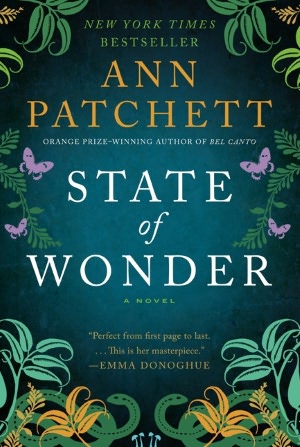
State of Wonder by Ann Patchett
A few people have asked me, what happened to my book blog~why had I stopped writing it? Don't worry. I'm still here, and I'm still reading. (My husband can vouch for that.) It just that it takes a while to find a best book, but State of Wonder by Ann Patchett certainly fits the bill.
I've read three of Patchett's other books: Bel Canto, Run, and Truth and Beauty, and State of Wonder is better than these. Maybe it appeals to me because of the medical/pharmacological plot. (I do love tales of pharmaceutical intrigue!) A Minnesota-based pharmaceutical company wants to keep tabs on its well-paid drug researcher in the Amazon, who is far less forthcoming about her progress than desirable. The company sends another scientist to find her and report back, with disastrous results. Instead of canceling the drug altogether (because of projected millions to be made), the company CEO sends yet another employee, Dr. Marina Singh, into the wild. The story of Dr. Singh searching and finding her erstwhile teacher/pharmaceutical savant is captivating. The Amazon jungle bubbles with snakes, mosquitoes, cannibals, and unforeseen surprises of a more human variety. The setting and character development of State of Wonder remind me very much of another best book~Barbara Kingsolver's African tale, The Poisonwood Bible.
The theme of travel as a route to self-knowledge has always fascinated me: it is irony at its richest. Indeed, Marina learns more about herself on this journey than she would have had she stayed in her beloved Minnesota. Sometimes, you have to go far away to discover what lies nestled in your very own cerebral cortex. Marina learns that long-gestating fears can be birthed in the most remote of locales, resulting in longed-for peace and homecoming.
Our family tends to be homebodies, and books like State of Wonder remind me how transforming trips can be. Every day stress cues are gone, and you can focus on what's in front of you and learn. (I just don't want to go to the Amazon jungle~malaria is best experienced textually rather than biologically.)
Sunday, July 22, 2012
Jeneration X by Jen Lancaster
We're smack-dab in the middle of summer, and if you have nothing to read, may I suggest Jeneration X: One Reluctant Adult's Attempt to Unarrest her Arrested Development... by Jen Lancaster? Gut-poppingly funny, it goes so well with the season's Crystal Light and chlorinated hair.
Lancaster has turned her unapologetic, self-deprecating memoirs into quite the cottage industry. Her first, Bitter is the New Black, detailed her humbling, yet humorous, journey through unemployment. This latest installment (#6) is my favorite because her humor, always nodding at nostalgia, full-on nails the peccadilloes and foibles of those of us born in the 1960s and 70s, the Gen X-ers. I can't remember the last time I laughed so hard when reading. The usual "Jennsylvania" (title of her blog) themes are included: husband and pets and laziness, but Lancaster's upped the ante this time with nuggets particular to those in middle age. Her trip to the mammography clinic is endearing, if anything because Lancaster is proud she fit into the regular machine and didn't need the super sized one. She tests a skirted swimsuit (the wetsuit of middle-age), gives an uncomfortable bra the heave-ho, and decides spying on the neighbors is not a thrill but disgustingly t.m.i-provoking.
Reading Jeneration X, I felt like I was having lunch with a favorite friend. (I love listening while someone else does all the talking.) Lancaster knows how to dole out a story, one delicious bit at a time, and then hit you with a self-truth, so funny and true, you can't help but love her. To wit:
Almost as soon as I discovered a deep and abiding love for Panang Thai Curry, I discovered that I can't digest it. Maybe I don't have a tolerance for so much spice or it may be that I ruined by colon from years and years of running Artificial Red Dye #7 through it. Regardless, I need to case and desist with the Panang Thai Curry because I'm murdering myself from the inside out. [Lancaster's husband finally calls the restaurant and tells them never to sell this dish to his wife. She closes with this lesson:]
Reluctant Adult Lesson Learned:
Being a grown-up means not staying in an abusive relationship...even if it's just with your colon.
In fact, the whole book, which I devoured like my own Panang Thai Curry sans ill effects, was a wonderful affirmation that life in one's forties is much the same for all of us. We become our own mothers and fathers and start taking better care of our bodies and minds. Although, in Lancaster's (and my) case, it may be a little too late to keep sharp if your mind is comfortably ensconced in the 1980s. Her anecdote about becoming enthralled with the heretofore ho-hum song "Hysteria" by Def Leppard made me want to kiss her. I too heard this song on the radio a few months ago and can't get enough of it. I even created a Pandora station around it. Me love Def Leppard? What is happening?
It's just part of being Generation X, baby.
p.s. My friend T.M. and I went to a book signing by Lancaster a few months ago in our town. She is an engaging, composed speaker and very generous with her time. I highly recommend seeing her if you have the chance. Also, the assembled group of fans was gracious, unassuming, and not fashionable in the least. (My highest compliment, folks.)
Lancaster has turned her unapologetic, self-deprecating memoirs into quite the cottage industry. Her first, Bitter is the New Black, detailed her humbling, yet humorous, journey through unemployment. This latest installment (#6) is my favorite because her humor, always nodding at nostalgia, full-on nails the peccadilloes and foibles of those of us born in the 1960s and 70s, the Gen X-ers. I can't remember the last time I laughed so hard when reading. The usual "Jennsylvania" (title of her blog) themes are included: husband and pets and laziness, but Lancaster's upped the ante this time with nuggets particular to those in middle age. Her trip to the mammography clinic is endearing, if anything because Lancaster is proud she fit into the regular machine and didn't need the super sized one. She tests a skirted swimsuit (the wetsuit of middle-age), gives an uncomfortable bra the heave-ho, and decides spying on the neighbors is not a thrill but disgustingly t.m.i-provoking.
Reading Jeneration X, I felt like I was having lunch with a favorite friend. (I love listening while someone else does all the talking.) Lancaster knows how to dole out a story, one delicious bit at a time, and then hit you with a self-truth, so funny and true, you can't help but love her. To wit:
Almost as soon as I discovered a deep and abiding love for Panang Thai Curry, I discovered that I can't digest it. Maybe I don't have a tolerance for so much spice or it may be that I ruined by colon from years and years of running Artificial Red Dye #7 through it. Regardless, I need to case and desist with the Panang Thai Curry because I'm murdering myself from the inside out. [Lancaster's husband finally calls the restaurant and tells them never to sell this dish to his wife. She closes with this lesson:]Reluctant Adult Lesson Learned:
Being a grown-up means not staying in an abusive relationship...even if it's just with your colon.
In fact, the whole book, which I devoured like my own Panang Thai Curry sans ill effects, was a wonderful affirmation that life in one's forties is much the same for all of us. We become our own mothers and fathers and start taking better care of our bodies and minds. Although, in Lancaster's (and my) case, it may be a little too late to keep sharp if your mind is comfortably ensconced in the 1980s. Her anecdote about becoming enthralled with the heretofore ho-hum song "Hysteria" by Def Leppard made me want to kiss her. I too heard this song on the radio a few months ago and can't get enough of it. I even created a Pandora station around it. Me love Def Leppard? What is happening?
It's just part of being Generation X, baby.
p.s. My friend T.M. and I went to a book signing by Lancaster a few months ago in our town. She is an engaging, composed speaker and very generous with her time. I highly recommend seeing her if you have the chance. Also, the assembled group of fans was gracious, unassuming, and not fashionable in the least. (My highest compliment, folks.)
Thursday, April 12, 2012
Just for Liberal Arts Majors--The Marriage Plot by Jeffrey Eugenides
So what do you do with an English major?
One of the reasons I love Jeffrey Eugenides' novel The Marriage Plot is its similarly foggy main characters. Madeleine, Leonard, and Mitchell are Brown seniors in the early 80s who make up a traditional love triangle. Madeleine, the English major of the trio, tries to stretch her love of literature to accommodate the hip critical theories taught in class. Leonard, a brilliant manic depressive, and Mitchell, a Religion major smitten by Madeleine, are both bolder in intellectual and career plans than she is. As Madeleine finishes her senior year, she's a little lost: she starts to think her thesis on "the marriage plot" in 18th century novels is stodgy, irrelevant and reflective of how uncool she is compared to her peers. Her upper crust childhood of chintz and sanity slightly shames her, and she finds herself drawn to mysterious, charismatic Leonard. Hot college passion ensues, and, for once, Madeleine doesn't feel old-fashioned. But the flames dampen when Leonard is non-compliant with his medication, preferring mania over depression. To thicken the plot, the characters make some very bad choices. Should Madeleine marry the pharmaceutically reformed Leonard? No! Should Mitchell keep believing Madeleine will one day love him? Hell no! But these characters choose the bumpy road, and the wiser reader enjoys the ride.
Perhaps, the most compelling lesson of The Marriage Plot is that many bad choices can be fixed. One can dissolve a rotten marriage, resolve infatuation, and even craft a career from English courses. Madeleine decides to pursue a PhD in Victorian Studies and become a professor after all, a job which seems highly suited to her passion and background. The story ends by showing the lost finding their way, if only jaunt by jaunt. There's truth to this pattern: college graduation forces us out into the world, and we stumble and make mistakes. But we can correct these choices, sometimes several times, and in this way we move through the years. By middle age, you find that you've made a life.
Subscribe to:
Posts (Atom)


.jpg)